Sysmon Mirage v2
A controlled adversary emulation project covering three T1055 process injection techniques — Classic Win32 API, Direct Syscalls, and Indirect Syscalls — built from scratch in C and x64 Assembly.
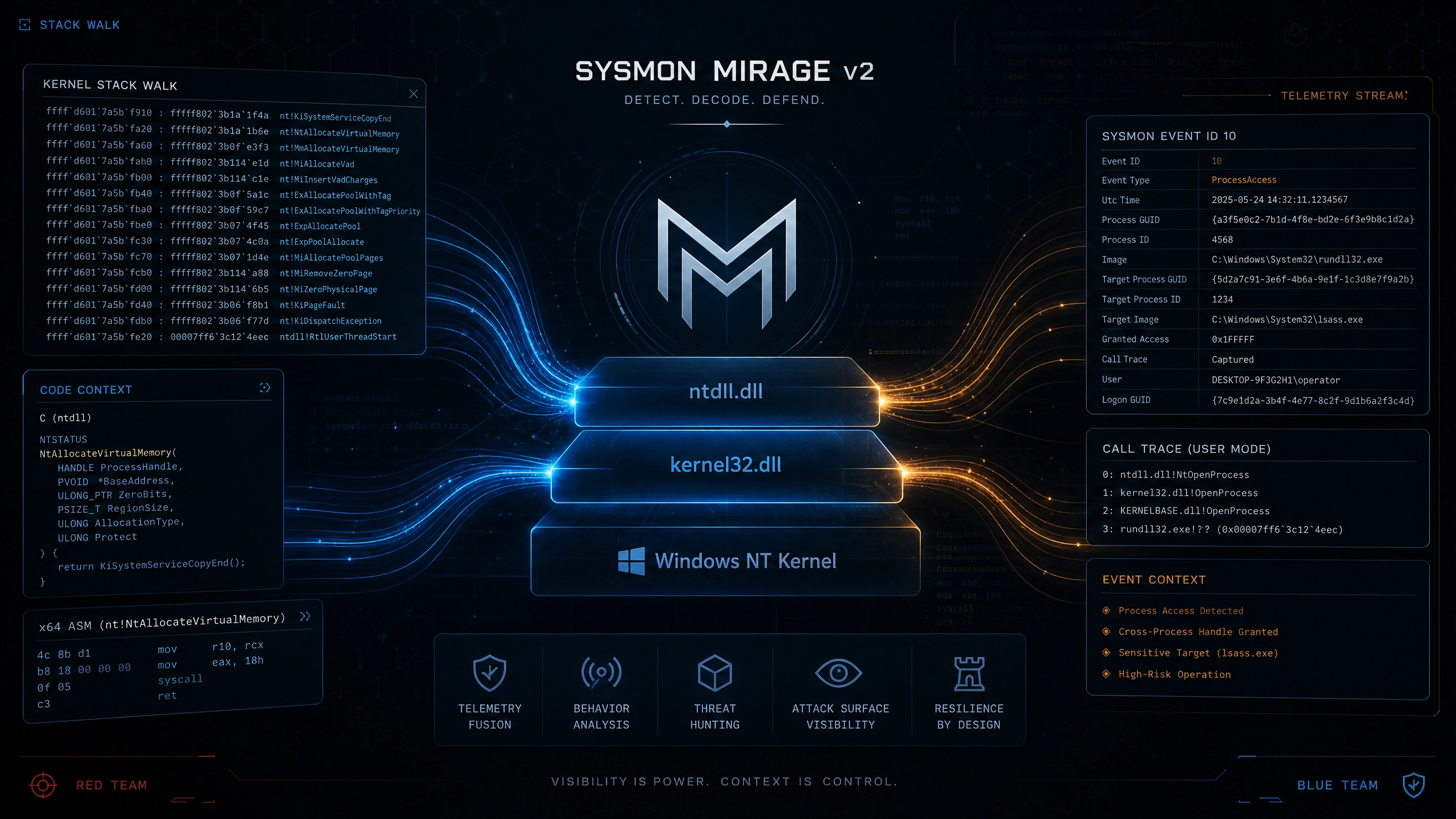
Introduction
Most detection engineering content on process injection explains what should happen.
This project focused on what actually happened when the code executed and the telemetry was captured directly from Sysmon.
Over the past month I built a controlled adversary emulation framework — Sysmon Mirage v2 — covering three T1055 process injection techniques implemented from scratch in C and x64 Assembly:
- Classic Win32 API injection using
CreateRemoteThread - Direct Syscalls executing the
syscallinstruction directly from injector-controlled memory - Indirect Syscalls borrowing the
syscallinstruction fromntdll.dllwhile preserving a custom syscall stub
The objective was intentionally narrow:
Run the same payload against the same target process using three different delivery mechanisms, capture the resulting telemetry, and compare what Sysmon actually observed at the kernel interaction layer.
Two findings directly contradicted widely published assumptions.
Those findings became more valuable than the original project itself.
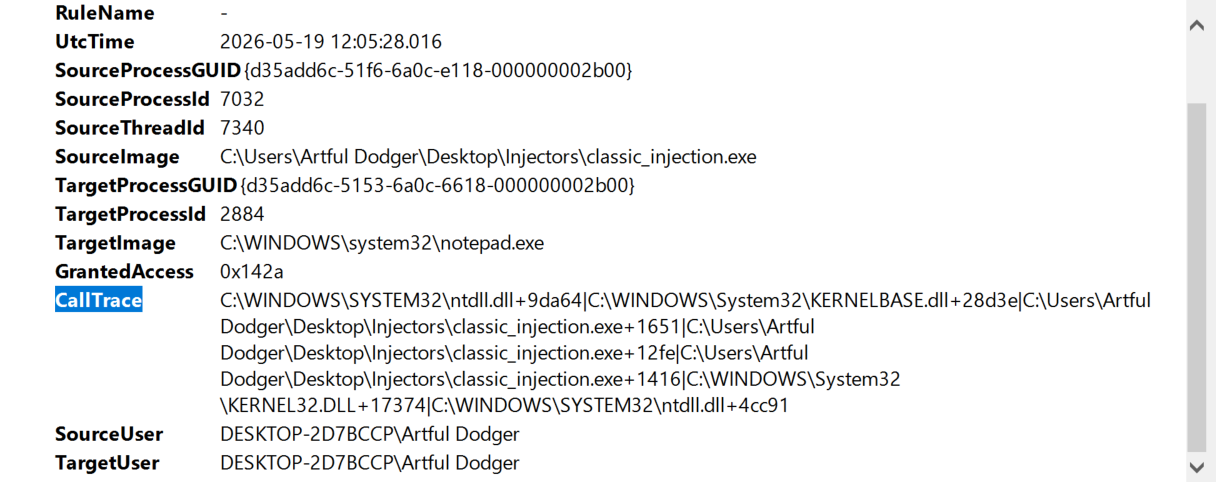 | 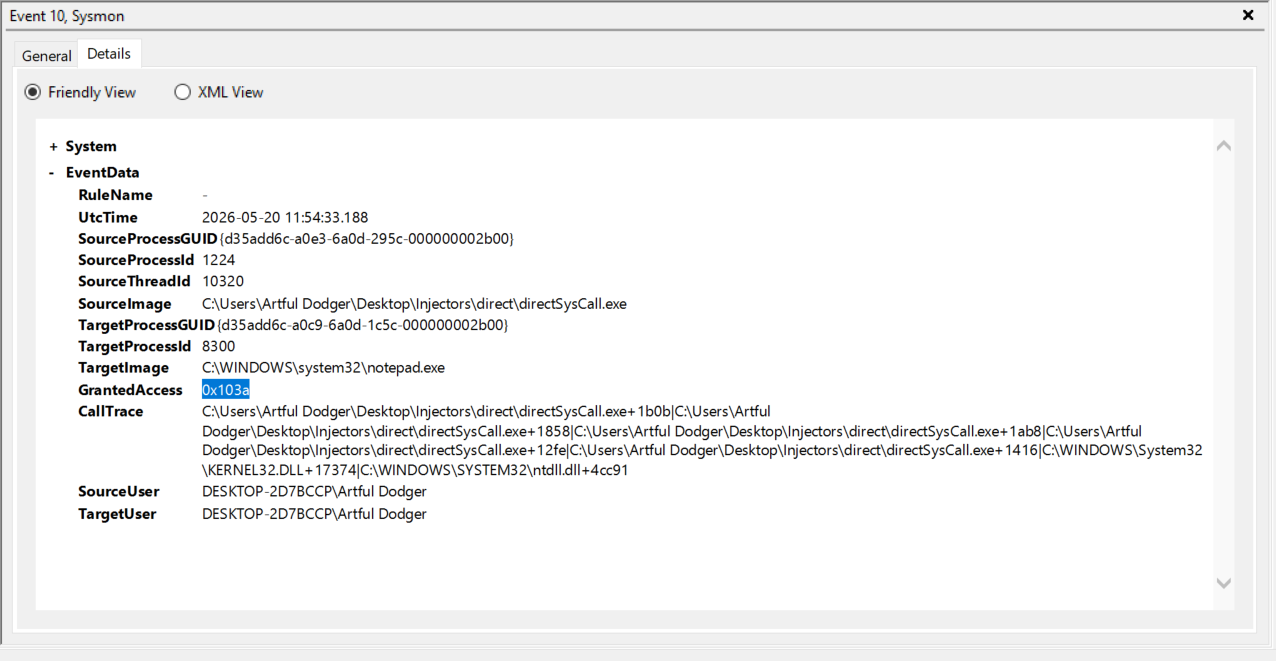 | 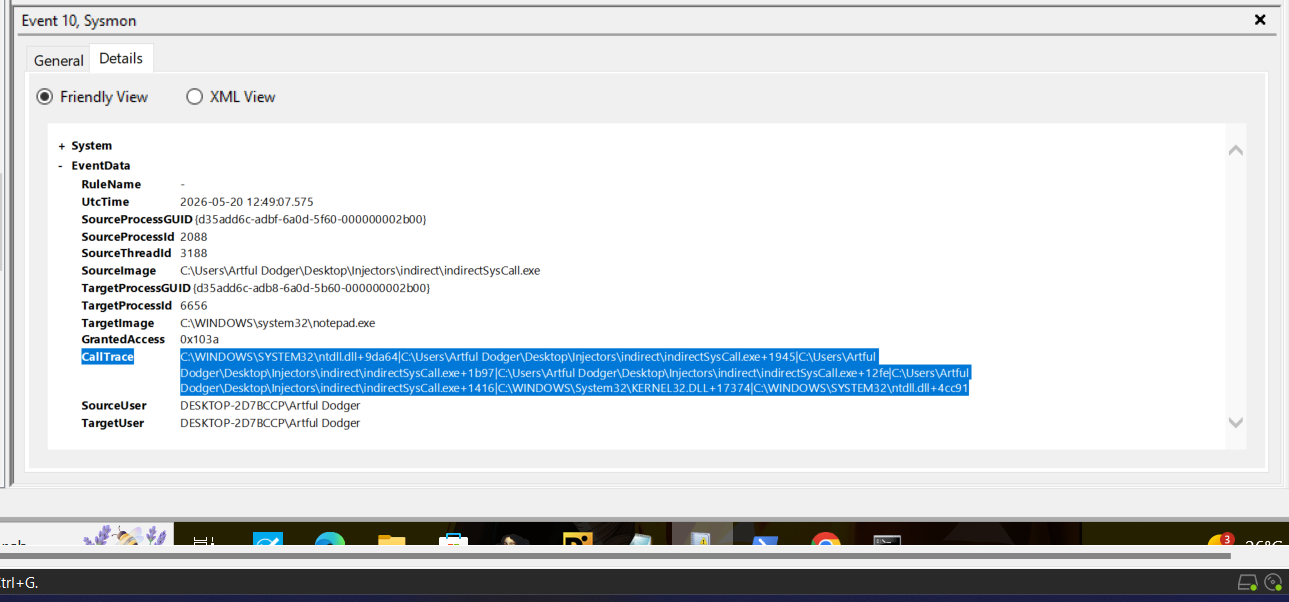 |
Figure 1 — EID 10 CallTrace behavior across Classic Win32 injection, Direct Syscalls, and Indirect Syscalls.
Key Findings
- Direct syscalls did not generate
UNKNOWNCallTrace entries on Windows 10 with Sysmon v15.20 - Indirect syscalls still generated EID 8
CreateRemoteThreadtelemetry - EID 10
ProcessAccessremained the most reliable universal detection anchor - CallTrace integrity changed measurably across all three injection methods
The Lab Environment
The testing environment was intentionally controlled to isolate telemetry differences to the injection mechanism itself rather than payload behavior.
| Component | Detail |
|---|---|
| Operating System | Windows 10 x64 |
| Sysmon Version | v15.20 — Schema 4.91 |
| EDR | None |
| Target Process | notepad.exe |
| Payload | x64 MessageBox shellcode |
| Injector Language | C + x64 Assembly |
| Compiler | MinGW + NASM |
No EDR was active during testing.
The purpose of the project was not bypass benchmarking. The focus was raw telemetry collection and detection engineering grounded in observable behavior rather than assumptions.
The Three Injection Techniques
Classic Win32 API Injection
Classic injection follows the documented Win32 process injection chain:
OpenProcessVirtualAllocExWriteProcessMemoryCreateRemoteThread
This technique generated predictable telemetry:
- EID 1 — Process Creation
- EID 8 — CreateRemoteThread
- EID 10 — ProcessAccess
The CallTrace appeared structurally legitimate, beginning with ntdll.dll before descending into the injector’s frames.
Detection is straightforward because the entire operation passes through heavily monitored Win32 API layers.
Direct Syscalls
Direct syscalls bypass user-mode API hooks by resolving syscall numbers dynamically and executing the syscall instruction directly from injector memory.
The resulting EID 10 telemetry produced a visibly broken call stack.
Instead of beginning with ntdll.dll, the CallTrace began inside attacker-controlled injector memory.
This became the primary behavioral indicator for direct syscall execution.
Indirect Syscalls
Indirect syscalls preserve the custom syscall stub while borrowing the actual syscall instruction from ntdll.dll.
At first glance the CallTrace appears more legitimate because ntdll.dll returns to the top of the chain.
However, injector-controlled frames remain visible deeper in the stack walk.
Sysmon still captures the transition.
What the CallTrace Actually Showed
Three techniques produced three distinct CallTrace structures despite using the same payload and target process.
That distinction became the most valuable telemetry artifact in the project.
Classic Injection — EID 10
1
2
3
4
5
6
7
8
9
C:\WINDOWS\SYSTEM32\ntdll.dll+9da64|
C:\WINDOWS\System32\KERNELBASE.dll+28d3e|
C:\Users\Artful Dodger\Desktop\Injectors\classic_injection.exe+1651|
C:\Users\Artful Dodger\Desktop\Injectors\classic_injection.exe+12fe|
C:\Users\Artful Dodger\Desktop\Injectors\classic_injection.exe+1416|
C:\WINDOWS\System32\KERNEL32.DLL +17374|
C:\WINDOWS\SYSTEM32\ntdll.dll+4cc91

GrantedAccess: 0x142A
The injector appears relatively deep within an otherwise legitimate-looking stack.
Classic injection relies on the Win32 layer and makes no attempt to conceal stack structure.
Direct Syscalls — EID 10
1
2
3
4
5
6
7
8
9
C:\Users\Artful Dodger\Desktop\Injectors\direct\directSysCall.exe+1b0b|
C:\Users\ArtfulDodger\Desktop\Injectors\direct\directSysCall.exe+1858|
C:\Users\Artful Dodger\Desktop\Injectors\direct\directSysCall.exe+1ab8|
C:\Users\Artful Dodger\Desktop\Injectors\direct\directSysCall.exe+12fe|
C:\Users\Artful Dodger\Desktop\Injectors\direct\directSysCall.exe+1416
C:\WINDOWS\System32\KERNEL32.DLL+17374|
C:\WINDOWS\SYSTEM32\ntdll.dll+4cc91

GrantedAccess: 0x103A
The injector appears at the very top of the stack.
ntdll.dll is absent from the expected leading position.
That broken stack integrity became the strongest detection signal for direct syscall execution.
Indirect Syscalls — EID 10
1
2
3
4
5
6
7
8
9
C:\WINDOWS\SYSTEM32\ntdll.dll+9da64|
C:\Users\Artful Dodger\Desktop\Injectors\indirect\indirectSysCall.exe+1945|
C:\Users\Artful Dodger\Desktop\Injectors\indirect\indirectSysCall.exe+1b97|
C:\Users\Artful Dodger\Desktop\Injectors\indirect\indirectSysCall.exe+12fe|
C:\Users\Artful Dodger\Desktop\Injectors\indirect\indirectSysCall.exe+1416|
C:\WINDOWS\System32\KERNEL32.DLL+17374|
C:\WINDOWS\SYSTEM32\ntdll.dll+4cc91

GrantedAccess: 0x103A
ntdll.dll returns to the top of the stack, but the injector’s own frames remain visible mid-chain.
The stack appears cleaner than direct syscalls, but it is still distinguishable from legitimate behavior.
Finding 1 — UNKNOWN Never Appeared
Finding: Modern Sysmon versions did not produce
UNKNOWNCallTrace entries for direct syscalls.
Before testing began, the original detection hypothesis focused heavily on UNKNOWN entries appearing in the CallTrace field during direct syscall execution.
That pattern never appeared.
Not once.
Not across repeated executions on Windows 10 using Sysmon v15.20.
Instead, the consistent signal was the injector’s own executable path appearing at the top of the stack walk.
This changes how direct syscall detections should be structured on modern systems.
Detection rules relying primarily on:
1
CallTrace contains UNKNOWN
will fail silently in this environment.
The final Sigma logic was rewritten to prioritize broken stack integrity and injector-controlled memory frames instead.
Finding 2 — Indirect Syscalls Still Generated EID 8
Finding: Indirect syscalls still generated CreateRemoteThread telemetry.
This contradicted nearly every public explanation surrounding indirect syscall execution.
The common assumption is:
- Win32 APIs generate EID 8
- Direct and indirect syscalls bypass EID 8 entirely
That assumption did not hold during testing.
Every indirect syscall execution produced:
- EID 8 —
CreateRemoteThread
with:
1
StartModule: -
The most likely explanation is that Sysmon’s kernel callback mechanism captures thread creation independently of whether the request originated through Win32 APIs or syscall execution.
The underlying kernel operation remains identical.
That has two important implications:
- EID 8 has broader detection coverage than commonly documented
- Absence of EID 8 should not be treated as evidence of advanced syscall-based injection
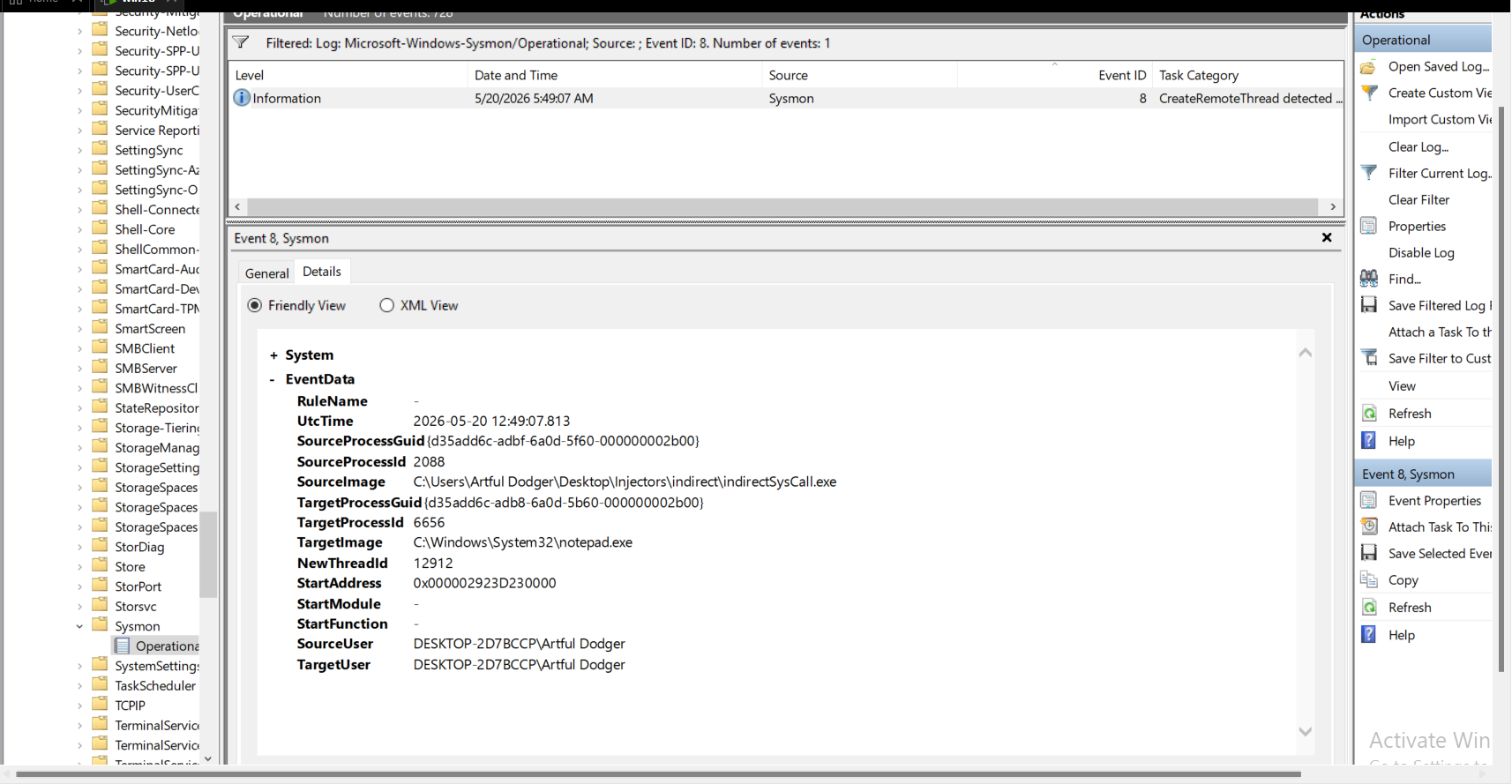
— Indirect syscall execution still generating EID 8 CreateRemoteThread telemetry.
EID 10 as the Universal Detection Anchor
Across all three techniques, one event remained completely consistent:
- EID 10 —
ProcessAccess
Every injection method required privileged access to the target process before execution could occur.
That access request consistently generated telemetry regardless of how advanced the injection mechanism became.
This made EID 10 the most reliable behavioral anchor for T1055 detection engineering.
| Injection Technique | Observed GrantedAccess | Notes |
|---|---|---|
| Classic Win32 API | 0142A | Standard CreateRemoteThread flow |
| Direct Syscalls | 0x103A | Broken CallTrace integrity |
| Indirect Syscalls | 0x103A | ntdll restored at stack top |
The direct syscall injector also generated a separate low-privilege WTS enumeration event before injection occurred.
That sequence created a useful behavioral chain:
- Process enumeration
- Privileged handle acquisition
- Remote thread execution
The telemetry sequence itself became detectable.
Where Detection Breaks Down
No detection framework is complete without documenting where it fails.
Several important limitations emerged during testing.
Memory Allocation and Write Operations Remain Invisible
VirtualAllocEx and NtWriteVirtualMemory generated no direct Sysmon telemetry.
By the time EID 10 appears, the payload has already been written into the remote process.
The detection occurs after compromise activity has already begun.
Stack Spoofing Defeats CallTrace Analysis
CallTrace-based detection assumes stack integrity remains intact during Sysmon’s stack walk.
An injector implementing stack spoofing can replace or manipulate stack frames before telemetry capture occurs.
When that happens:
- direct syscalls can resemble legitimate API activity
- indirect syscalls become significantly harder to distinguish
- CallTrace reliability degrades rapidly
BYOVD Removes Sysmon Visibility Entirely
Bring Your Own Vulnerable Driver attacks can unregister Sysmon kernel callbacks completely.
In that scenario:
- the injector still executes
- the system appears healthy
- telemetry collection silently stops
Understanding where telemetry disappears is as important as understanding where it exists.
The Detection Rules
Three Sigma rules were built directly from observed telemetry patterns.
| Rule | Primary Selector | Confidence |
|---|---|---|
win_classic_win32_injection.yml | EID 8 + StartModule: - | High |
win_direct_syscall_injection.yml | Broken CallTrace integrity | High |
win_indirect_syscall_injection.yml | ntdll-top with injector mid-chain | Medium |
The final rules intentionally avoided assumptions tied to:
- specific execution paths
- user directories
- hardcoded injector names
UNKNOWNstack artifacts
The focus remained behavioral rather than environmental.
Lessons Learned
The most valuable outcome of the project was not the injection framework itself.
It was the gap between documentation and reality.
Patterns repeatedly described in public resources failed to appear during testing, while other telemetry artifacts consistently emerged despite claims that they should not exist.
The practical lesson was simple:
Documentation is not ground truth.
Telemetry is.
Reliable detection engineering begins with direct observation inside controlled environments rather than assumptions inherited from older research.
Repository
The complete research project — including injector implementations, Sysmon configuration, Sigma detection rules, telemetry analysis, and supporting documentation — is available on GitHub: